Pharmaceutical process development: From Route Scouting to Full Production Support
At AGC Pharma Chemicals, our Process Development services include route scouting, process optimization, and analytical method development, along with stability studies, that span from early phases to commercialization.
Our team of highly qualified scientists works with state-of-the-art technology to develop and optimize API synthesis processes. Always with innovative approaches to find cost-efficient solutions, enabling complex molecules to reach the market quickly without compromising quality.

Our services for API Process Development
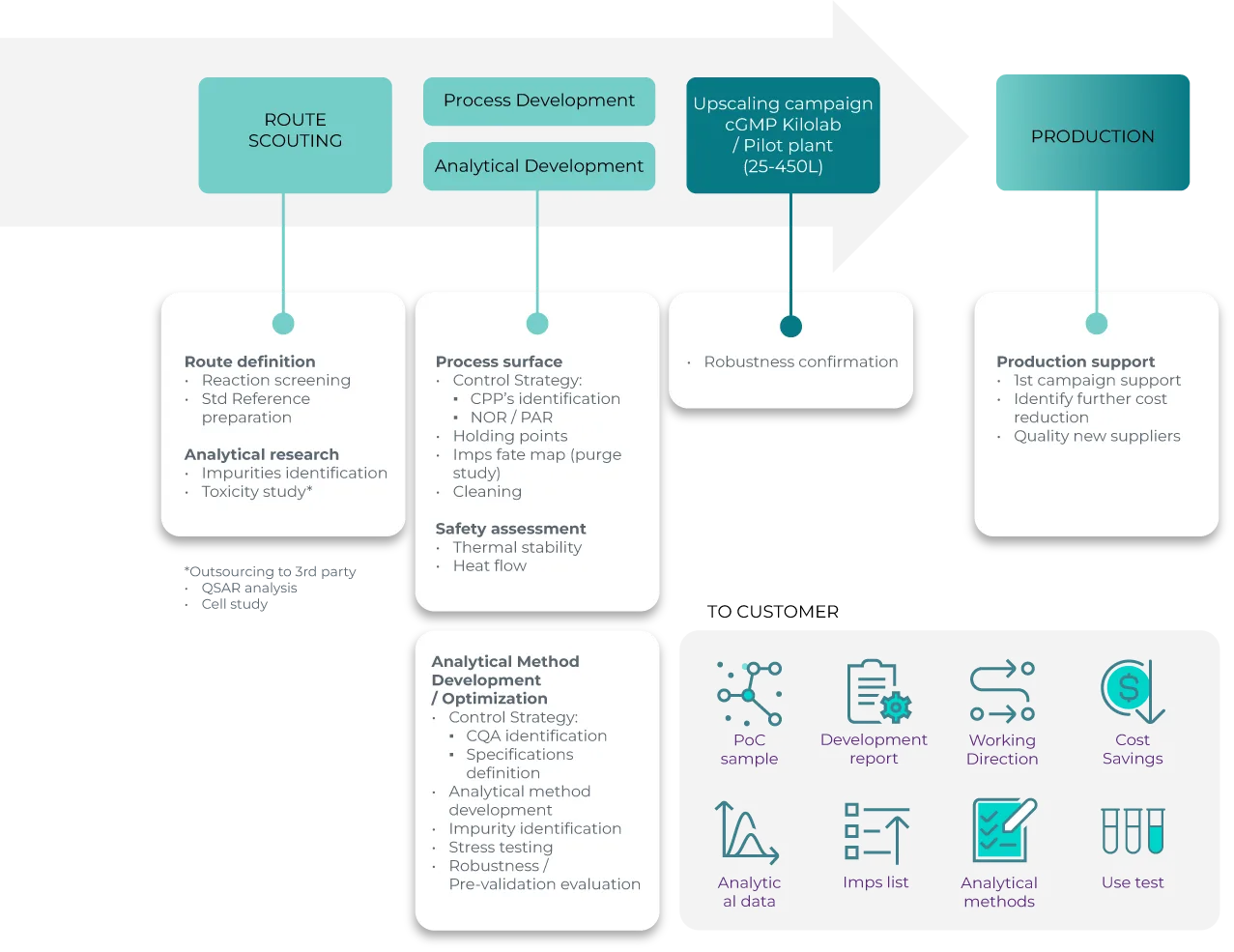
Process Development – service outline
Pharmaceutical Process Development
Effective pharmaceutical process development bridges the gap between discovery chemistry and commercial manufacturing.
Processes that perform well at gram scale often encounter significant challenges when transferred to larger equipment. Reaction kinetics may change, impurity profiles can evolve, heat transfer characteristics become more complex, and raw material variability may impact reproducibility.
For this reason, process development must focus not only on chemistry but also on manufacturability.
At AGC Pharma Chemicals, we approach API process development as an integrated discipline that combines:
- Route Scouting
- Process Development & Optimization
- Analytical Development
- Scale-up Campaigns
- Commercial Manufacturing Support
Route Scouting and Analytical Research
The first stage of successful API process development is selecting the most appropriate synthetic route.
We focus on selecting efficient, scalable, and economically viable pathways that can support future manufacturing requirements while maintaining product quality and regulatory compliance.
Route Scouting and Early Analytical Assessment
During route scouting activities, our scientists perform:
- Reaction screening studies
- Synthetic route evaluation and comparison
- Starting material assessment
- Standard reference preparation
- Reagent and catalyst selection
- Preliminary process safety evaluations
Rather than focusing exclusively on laboratory performance, we assess each route from a manufacturing perspective, evaluating scalability, raw material availability, impurity risks, environmental impact, and cost of goods.
Analytical Support During Route Selection
To strengthen route selection decisions, our teams also perform:
- Impurity identification and characterization
- Preliminary impurity pathway assessment
- Toxicological risk evaluation
- QSAR analysis through qualified external partners
- Cell-based toxicity studies when required
These activities help identify potential development challenges early and provide a stronger foundation for subsequent process optimization activities.
Process Development and Process Optimization
Once a route has been selected, the next step is process optimization and control strategy development.
Our custom API development programs focus on improving process performance while building a deep understanding of the chemistry and critical process parameters involved.
The objective is to create a process that consistently delivers high-quality material while remaining economically and operationally viable at manufacturing scale.
Process Characterization and Process Understanding
A key objective of API process development is building a thorough understanding of process behavior.
Our development teams establish comprehensive process knowledge through:
- Control strategy development
- Critical Process Parameter (CPP) identification
- Normal Operating Range (NOR) definition
- Proven Acceptable Range (PAR) studies
- Holding point evaluations
- Process robustness assessments
This scientific understanding allows us to define process operating windows that support consistent product quality and manufacturing reproducibility.
Impurity Fate Mapping and Purge Studies
Understanding impurity behavior is essential for successful pharmaceutical manufacturing.
Our scientists conduct:
- Impurity fate mapping
- Purge factor studies
- Process-related impurity tracking
- Residual reagent evaluation
- Cleaning assessments
These studies support impurity control strategies and facilitate future regulatory submissions.
Process Safety Assessment
Process safety is fully integrated into our pharmaceutical process development approach.
As processes move toward larger manufacturing scales, understanding thermal behavior and reaction risks becomes increasingly important.
Our teams perform:
- Thermal stability evaluations
- Heat flow studies
- Reaction calorimetry assessments
- Process hazard evaluations
- Scale-up safety reviews
These studies provide critical information for safe manufacturing operations and support successful technology transfer into pilot and commercial facilities.
Analytical Method Development and Optimization
Analytical science plays a central role throughout API process development.
Reliable analytical methods provide the information required to monitor process performance, characterize impurities, establish specifications, and maintain product quality throughout development and manufacturing.
Control Strategy Development
Our analytical scientists work closely with process chemists to establish robust analytical control strategies.
Capabilities include:
- Critical Quality Attribute (CQA) identification
- Specification development
- Analytical control strategy design
- Regulatory readiness assessments
Analytical Method Development
Our laboratories support:
- HPLC and UHPLC method development
- Gas chromatography methods
- Stability-indicating methods
- Assay development
- Residual solvent analysis
- Impurity profiling
Analytical Method Optimization and Qualification
Additional activities include:
- Impurity identification
- Stress testing studies
- Robustness testing
- Method qualification
- Pre-validation evaluation
These activities ensure analytical methods are suitable for process development, scale-up, validation, and future commercial manufacturing.
Scale-Up in cGMP Kilolab and Pilot Plant Facilities
Scale-up represents one of the most critical stages in API process development.
Processes that perform successfully at laboratory scale must demonstrate equivalent performance in manufacturing environments.
AGC Pharma Chemicals supports scale-up campaigns through dedicated cGMP Kilolab and Pilot Plant facilities with reactor capacities ranging from 250 L to 450 L.
Scale-Up Capabilities
Our teams provide:
- Kilolab campaigns
- Pilot plant campaigns
- Process characterization
- Engineering batch execution
- Technology transfer support
- Manufacturing readiness assessments
Robustness Confirmation
A central objective of scale-up activities is robustness confirmation.
During this phase, we verify:
- Process reproducibility
- Equipment compatibility
- Manufacturing consistency
- Operational robustness
- Commercial scalability
This information significantly reduces technical risks before commercial production.
Production and Commercial Manufacturing
Our involvement continues beyond process development and scale-up.
AGC Pharma Chemicals provides ongoing technical support to facilitate successful commercial manufacturing implementation.
Production Support Services
Capabilities include:
- First campaign manufacturing support
- Process troubleshooting
- Process performance monitoring
- Identification of additional cost-saving opportunities
- Continuous improvement initiatives
- Qualification of new suppliers
These activities help ensure manufacturing efficiency while supporting long-term product quality and supply reliability.
Challenges and solutions in the synthesis of APIs
To address the complexity of APIs, the pharmaceutical industry establishes strong partnerships with CDMOs that offer a comprehensive service for all phases of API development.
Trends in properties and API development
The core of the pharmaceutical production relies on the Active Pharmaceutical Ingredients (APIs), which are the essential components responsible for the therapeutic action of the drugs.
AGC Pharma Chemicals and AbilityPharma work together to produce innovative treatment for pancreatic cancer
AGC Pharma Chemicals and AbilityPharma work together to manufacture an API for an innovative new treatment for pancreatic cancer.
Frequently Asked Questions
What is API process development?
API process development is the scientific and engineering activity of designing, optimizing, controlling, and scaling manufacturing processes for active pharmaceutical ingredients from laboratory development through commercial production.
What is included in custom API development?
Custom API development includes route scouting, process optimization, impurity control strategies, analytical method development, scale-up studies, and commercialization support tailored to the specific requirements of a customer’s molecule.
How does pharmaceutical process development support commercial manufacturing?
Pharmaceutical process development establishes the scientific and technical foundation required for successful manufacturing. By identifying critical process parameters (CPPs), defining control strategies, evaluating impurity behavior, and confirming process robustness, development activities help ensure that manufacturing processes can consistently deliver high-quality material at commercial scale.
This work reduces scale-up risks and facilitates technology transfer into pilot and commercial manufacturing facilities.
How do analytical methods support pharmaceutical process development?
Analytical methods provide the data needed to monitor reactions, characterize impurities, establish specifications, and verify product quality throughout pharmaceutical process development.
Analytical method development typically includes impurity identification, stress testing, robustness studies, method qualification, and validation activities that support both development programs and future commercial manufacturing.
How does AGC Pharma Chemicals approach scale-up during API process development?
AGC Pharma Chemicals integrates scale-up considerations throughout the API process development program. Processes are evaluated for manufacturability, process safety, robustness, and equipment compatibility before entering cGMP Kilolab and Pilot Plant campaigns.
Scale-up activities help confirm process reproducibility and manufacturing readiness while reducing technical risks associated with commercial production.